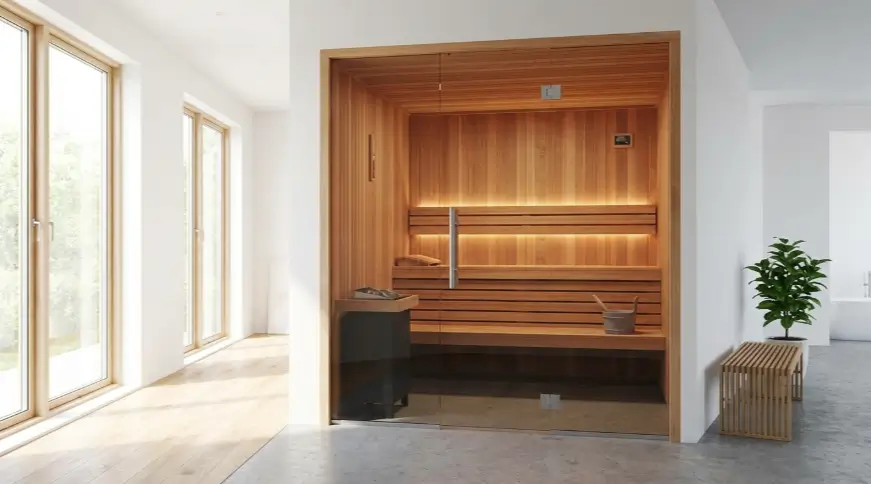
An indoor sauna used three to five times a week typically costs $18 to $40 a month in electricity, less than a comparable outdoor unit because it isn’t losing heat to wind and cold ambient air. The real number depends on heater wattage, session length, local electricity rates, and how well the room around the cabin holds heat and humidity.
What drives the monthly electric bill for an indoor unit?
Start with the heater. A two- to four-person indoor cabin usually runs a 6 kW electric heater, and a 45-minute session, including the 15 to 20 minutes it takes to reach 170°F, draws about 4 to 5 kilowatt-hours. At the current U.S. average residential rate near 16 cents per kWh, that works out to roughly 65 to 80 cents a session. Four sessions a week lands around $12 to $14 a month before you factor in a bigger cabin or a longer soak.
Because the unit sits inside a conditioned home rather than a backyard, it isn’t reheating against 20°F outdoor air or a stiff wind stripping heat off the exterior walls. That single difference is often the largest reason an indoor sauna’s monthly cost runs lower than an outdoor cabin of the same size and heater output.
How much does heater type change the number?
Traditional Finnish-style heaters warm both the air and the stones, so the room needs to climb to 170°F to 195°F before the session really starts. Indoor infrared cabins skip most of that step. The panels heat your body directly rather than the surrounding air, so they typically run on 1.5 kW to 3 kW for a two-person unit and reach a usable temperature in under 15 minutes. That difference alone can cut the electricity portion of a household’s sauna habit by half, which is a big reason infrared has become the default pick for a spare bedroom or finished basement corner where a large traditional heater isn’t practical.
Plug-in infrared units that run on a standard 120V outlet sidestep new wiring costs entirely, though they draw more amperage on a shared household circuit and shouldn’t run alongside a space heater or hair dryer on the same line.
See also: The Future of Smart Technology in Communication Infrastructure
What should you budget beyond electricity?
Heater rocks lose efficiency over one to two years of regular use and typically cost $30 to $80 to replace. Interior cedar or hemlock benefits from an occasional light sanding, especially in a room without strong ventilation, since indoor humidity lingers longer than it would outdoors. If the room doesn’t already have a bathroom-grade exhaust fan, adding one to clear residual moisture after each session is a one-time cost worth paying up front rather than dealing with a musty smell or soft drywall a year later.
Before settling on a size, it helps to compare a few cabin footprints against your actual electrical panel capacity and room dimensions rather than guessing. You can browse SweatDecks indoor saunas to see how heater wattage and estimated monthly running cost scale between a compact two-person infrared cabin and a larger four-person traditional build.
See also: The Future of Smart Technology in Communication Infrastructure
Does an indoor sauna change your home heating and cooling costs?
A sauna room releases warmth and humidity into the house for an hour or two after each use. In winter that can slightly reduce how hard your furnace works in nearby rooms. In summer, the opposite happens, and your air conditioning may run a bit more to clear the extra heat and moisture. Neither effect is large next to the heater’s own draw, but it’s worth knowing about if the sauna sits near a thermostat, since a warm, humid room can throw off the reading for the rest of the house.
How does session frequency change the yearly total?
Most of the cost estimates above assume three to five sessions a week, but actual habits vary a lot once a household settles in. A single daily user with a small infrared cabin might spend closer to $10 a month, since one person cycling the heater once a day uses less total kilowatt-hours than a family taking turns through several sessions in an evening. A household of four sharing one cabin, each taking a 20-minute turn most nights, can push the same unit into the $35 to $50 a month range simply because the heater is cycling on and off for a longer stretch of the evening rather than running once and cooling down.
It’s also worth noting that heater cycling, not just total run time, affects the bill. A heater holding steady at 175°F draws less power than one repeatedly reheating after the door opens and closes between users. Households that batch sessions back-to-back, rather than spacing them out with long gaps, tend to see a slightly lower total than the simple math of multiplying session cost by number of users would suggest, since the cabin doesn’t fully cool down between turns.
Is the running cost worth it compared with a gym or spa membership?
A single visit to a public sauna or spa commonly runs $20 to $40. At that rate, a household saunaing four times a month at a facility spends more in a single month than a home electric unit typically costs to run for an entire year. The upfront purchase and any electrical work are the real investment; the ongoing running cost is usually the smallest line item once the first year is behind you.
There is a reasonable, evidence-based case for making regular sauna use part of a home routine rather than an occasional treat. A widely cited Mayo Clinic Proceedings review found sauna bathing is associated with a range of cardiovascular benefits, and a systematic review of dry sauna bathing reported consistent associations with better circulation and perceived recovery. These are association findings, not proof that sauna use alone prevents disease, but they help explain why so many households treat an indoor unit as a long-term fixture rather than a novelty.
Frequently Asked Questions
How much does it cost to run an indoor sauna every month?
Most households running an indoor electric sauna three to five times a week spend $18 to $40 a month on electricity. The exact figure depends on heater wattage, session length, and local electricity rates, with a small indoor infrared cabin usually landing at the low end.
Is an indoor sauna cheaper to run than an outdoor one?
Usually yes, because an indoor cabin is not fighting wind, rain, or freezing ambient air. A unit installed inside a heated home holds its target temperature with less heater cycling, which trims the electricity a comparable outdoor sauna would use over a winter.
Does running an indoor sauna affect my home’s heating and cooling bill?
A little. A sauna room releases residual heat and humidity into the surrounding space for an hour or two after a session, which can nudge your HVAC system to run slightly less in winter and slightly more in summer, though the effect is usually small compared to the heater’s own draw.
What non-electrical costs come with an indoor sauna?
Budget for heater rock replacement every one to two years, occasional resealing of interior wood, a bathroom-grade exhaust fan if one is not already installed, and periodic checks of the vapor barrier behind the cabin walls to catch moisture problems early.
Do I need a dedicated electrical circuit for an indoor sauna?
Most freestanding indoor cabins built for two or more people need a dedicated 240V circuit sized to the heater, typically 30 to 50 amps. Small plug-in infrared units are the exception and can often run on a standard 120V household outlet.
References
- Cardiovascular and Other Health Benefits of Sauna Bathing: A Review of the Evidence, Mayo Clinic Proceedings, 2018
- Clinical Effects of Regular Dry Sauna Bathing: A Systematic Review, Evidence-Based Complementary and Alternative Medicine, 2018
- Benefits and risks of sauna bathing, The American Journal of Medicine, 2001
- Saunas and your health, Harvard Health Publishing
By Derek Holloway